Sunday, July 5, 2009

On The Road Again........

It feels great to finally be underway again. Our stop on the Cumberland River this Spring proved to take much longer than we expected. We arrived at Eddy Creek Marina in late April just in time to catch a flight for a visit with the Idaho contingent of our family.

In most of the central part of the Country it was a rainy Spring and Kentucky was no exception. We had planned to take a short trip up the Cumberland when we returned from Boise and before the canvas maker was ready to start on our top, however those plans had to be put on hold due to flooding on the Cumberland River.

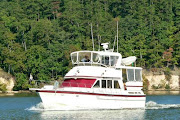
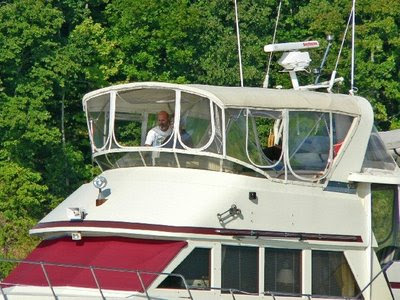
As with most "home improvement" project, the work on our new fly bridge enclosure took longer than anticipated. The end result being that we ended up staying at Eddy Creek for six weeks instead of a month. Normally this time of the year is prime cruising weather but the rainy Spring made us sort of glad to have a roof over our head, so to speak. The new fly bridge enclosure is great and we are nice and dry and have windows we can actually see out of as we continue our odyssey.


The "gowrong" fairy visited the day we departed Eddy Creek. What, you ask, is a gowrong fairy? She is the standard bearer of the old adage "Anything that can go wrong will." We were excited and ready to be underway again but the longer you are at a dock the more completely you "move in" and so we had a lot of "stuff" to put back in place aboard Lauren Grace. The morning of any departure you must unhook the electric power cords and the TV cable (if you have it) and stow those as well. Of course we are unplugging the electricity just when we want that morning coffee and tea, because our boat does not have an inverter this means we must start the generator in order to keep the coffee hot. Also about this time we shorten up the lines so that we have just the bare minimum of one or two lines holding us to the dock. Of course, if you are lucky, a couple of the local dock residents stop by the say good-bye. Sometime during this process Larry got distracted, or maybe the gowrong fairy sprinkled invisible pixie dust over them, and the power cords never got put aboard. We motored out, fat dumb and happy to have a gorgeous day ahead of us. Looking forward to a new anchorage in the Land Between the Lakes. We have about one week to get to Joe Wheeler State Park where we plan a vacation rendezvous with my sister Christina and her family, our travel time is an easy 5 days so we have two days to use for delays from weather or to play with.

About 3 1/2 hours and 30 miles later we noticed a message on Larry's phone (which was down below so we never heard ring), it was to tell us that we had left the power cords lying on the dock at the marina! To say the captain was not happy would be a colossal understatement. We turned around and made our way back about 15 miles to Green Turtle Bay, took a slip for the night, borrowed their courtesy car and drove back to Eddy Creek to retrieve the cords. The really annoying thing was that the call had come less than 20 minutes after we left the dock and we were hardly out of the creek! Trying to make lemonade, I phoned Patti's restaurant to see if we could get in for dinner - not a chance (was I really expecting any other answer)!

The next day we really did get underway and made it to Pebble Isle Marina in New Johnsonville, TN. We have been there before and really like Pebble Isle, this time we went over to check out Johnsonville State Historic Park . This is the site of a small but unique military victory for the Confederacy. In November of 1864, in an effort to disrupt Union supply lines, General Nathan Bedford Forrest and his cavalry attacked and destroyed the river port depot of Johnsonville which had been seized by Union Forces. Forrest was successful and Union losses included three gunboats, eleven transports, 18 barges and over $8 million dollars in lost supplies. The most unique thing about this battle is that it is the only record of a naval force being engaged and defeated by a cavalry force!

In Tennessee there are many things named for General Forrest, a legendary cavalry officer who joined the Confederate Army in 1861 as a 40 year old private with no military training. Promoted to brigadier general in July 1862, he showed himself a cavalry leader of genius. Forrest ravaged Grant's communications in the winter of 1862/3 and did such damage in Sherman's rear during 1864 that Sherman announced that he ‘must be hunted down and killed if it costs ten thousand lives and bankrupts the Federal treasury’.


Of all the dams that we have transited Pickwick Dam near Pickwick Tennessee has always been the one that causes us the biggest delays, we have learned to allow extra time in our day when we are traveling through here. But this trip the forces of the universe smiled on us and we actually got through with no waiting! Good thing to because it was hot as hades that day and a long hot wait would not have been fun, actually waiting is never fun but here it is particularly bad because the channel is narrow, the current is often strong, and there is very little place to get out of the way of tow traffic and the turbulence from the discharge. The picture below shows the discharge from the lock that comes out on the lower end when they are lowering the chamber.


On Pickwick Lake there is a great pizza joint close to the marina, and the marina has a courtesy car. We had planned to anchor out because last night on the hook was just beautiful, however today is bloomin' hot and we needed to stop for fuel so we decided to stay at the marina and treat ourselves to pizza. I suppose it's no comparison to Patti's but it is really great pizza and we love that too. This place is great and I wanted to include a link in case you ever find yourself in Counce, TN with a hankerin' for something other than catfish but, alas, they have no website!

Joe Wheeler Park was a familiar stop for us, we have found it is nice to return to familiar marinas because we know what to expect in the docking situation and we already have the "lay of the land" - Wheeler is no exception. In fact we choose this as the rendezvous spot because we were familiar with the amenities available there. Christina's family arranged for one of the nice new lakeside cottages where they had room to spread out. My nieces and nephew enjoyed swimming & fishing off of the cottage dock. Once again we discovered that a ride on the big boat is boring for kids but they love anchoring and swimming off of the back.

Now we are underway again and traveled with three other boats from Wheeler up to Goose Pond Colony Marina on beautiful Guntersville Lake where we holed up for the big Fourth of July weekend. When local boaters are out enjoying their weekends on the water the wake can be excessive and we usually like to stay put during that time. The bonus here was that Goose Pond Colony is owned by the city of Scottsboro, AL and they had a great municipal fireworks display that we could see (and smell) right from our dock. We hope you all had a terrific & patriotic Fourth of July where ever you celebrated.




Thursday, July 2, 2009

Whew, have we been busy!

If you read the recent update you know we have been working all Spring. Some have asked to see the results of all those projects so here is a peek. Of course I can't, (or don't want to) photograph the wiring and other stuff that consumed so much of Larry's time so I'm showing off the pretty stuff that I contributed to!

New Curtains in the salon, that's boat speak for living room.

New Cushions!


Probably the most time consuming project for Theresa was the varnish work which doesn't photograph well. There isn't all that much wood; just the bottom rail that the door rests and slides on, the u-shaped top rail that holds it in place, and the vertical piece (also u-shaped) that stops and seals it. Lots of corners for varnish to run in, poor light, and a b**** to sand!


The white strip that is screwed to the newly finished wood is the glide runner that Larry fabricated out of starboard (a kind of plastic that is about the texture of a kitchen cutting board) what you don't see are the roller devices that he also fabricated that glide on the white strip and now the door, which used to bind, now opens as smooth as silk. Hooray!

The big ticket item was a new bimini top and enclosure for the fly bridge. Our bimini was very mildewed and was nearing the end of its useful life. The plastic window enclosures were way past their useful life and we are thrilled to have new windows we can see out of. This project was not much work on our part as it is beyond the scope of my sewing abilities or interests, all we had to do for this one was write a check.

The old top was cream colored and showed dirt and mildew very easily, this time we opted to go darker. Burgundy would have been nice, but with the sun beating down dark colors are very hot so we compromised and used beige Sunbrella with burgundy trim. We like the look but have already discovered that it is indeed hotter than the cream was, the good news is that the dirt does not show as easily.

Thursday, November 13, 2008

Those Majestic Tows

Cruising on the rivers we encounter a lot of tows. When we were still sailing on the river we always referred to them as barges, as in "do you see that barge coming". But the truth is that the towboat pushes individual barges, usually more than one and generally as many as 15 lashed together 3 across and 5 deep; the entire assembly is referred to as a "tow". The 15 barge tow that I mentioned is the norm on the Upper Mississippi but on the lower Mississippi (below Cairo, IL) a towboat may push as many as 40 barges. On the rivers that we have traveled on there is no "towing" involved but in the Chesapeake and the Gulf of Mexico we have observed barges being towed.
Whatever you choose to call them I think they are one of the most majestic sights we encounter on the waterway. You may not call them beautiful but they are awesome in their quiet power. Plying the waterways 24/7 they operate in all extremes of weather.
A tow boat Captain has the tow strung out in front of him about 1/4 mile (on a standard 15 barge tow) and he has to maneuver it around corners and into locks and docks and loading facilities. All of the propulsion for forward movement and maneuvering is on the towboat, the barges themselves have no propulsion. Just imagine trying to maneuver into a lock that is only a few feet wider than your 3 lead barges. Now imagine doing it in the dark, in the rain (or snow or fog), yikes! These guys are very skilled and they are also generally helpful to pleasure boaters, or RVs (recreational vessels) as they sometimes refer to us.

Barge transportation is incredibly efficient. Each barge can carry 1,500 Tons, or 52,500 Bushels or 453,600 Gallons. The capacity of a single barge is 15 times greater than one rail car and 60 times greater than one semi trailer.

Generally speaking towboats are kept clean and freshly painted. When the crew does not have deck duties they utilize the time to see to scrubbing or painting the towboat, it is a huge floating billboard for the corporation that owns it.


We have had the opportunity to lock through with tows on several occasions. The first time we were apprehensive because we had heard stories but our experience was that the tow Captain was very courteous and also very conscious of our safety and comfort as well as the safety of our boat.


Wednesday, November 12, 2008

Down the Big Rivers

There are a lot of "big" rivers in this Country but I am referring to two of the largest, the Mississippi and Ohio. Native Americans called the Mississippi the Father of the Waters and Ohio was from an Iroquois word meaning "Great River".


We left Portage Des Sioux just after a flood and while the waters had receded and most of the floating debris had run off we still needed to be alert. As you can see from this shot taken as we were entering Mel Price Lock at Alton, Illinois not all of the "junk" was gone. Actually it had sort of "coalesced" here where the water is slack above the lock. We try to shift out of gear so that the props are not spinning and sort of glide through the logs before we re-engage the props.
Our traveling companions "Mojo" and "Telegraph Hill" exiting Mel Price Lock. Bill & Donna on "Telegraph Hill" are friends from Sioux Harbor who have decided to travel down with us.


The waves on the water between the bow of "Lauren Grace" and the island in the distance are caused by the flow of the Missouri River into the Mississippi. This is the confluence of the "Big Muddy", as the Missouri is called, and Mississippi. The water color is usually markedly different but not so much today due to the recent flooding. The current really picks up from this point due to the fast current of the free flowing Missouri and that is why you see the waves.


This canal leads the way to the final lock on the Mississippi. Occasionally boats miss this sign and follow the old riverbed, which leads them to a treacherous rocky area. In fairness to the boaters I must say that the charts are not clear at this junction, but the sign is large. Once through Lock 27 and out of the canal the Mississippi is open river with no controlling dams all the way to New Orleans.


Only a few miles downstream from Lock 27 is the city of St. Louis. The large stern wheeler in the foreground is the "American Queen" the biggest stern wheeler ever built; she was launched in 1995 when she joined the "Delta Queen" and the "Mississippi Queen" plying the rivers and carrying passengers wanting to re-live the luxury days of riverboat travel. Many times we have seen these boats on the waters, at night they sparkle like crystal palaces and when they go through a lock they give a steam calliope concert. This was the custom when a riverboat called at a town back in the day, if we are near the lock we always hang out to hear the concert. In recent years river travel has fallen on hard times and the boats were sold several times. The "Delta Queen" has likely taken her last voyage but the fate of the much newer American and Mississippi Queens is unknown.


A bit of the St. Louis skyline


The old PET Incorporated headquarters building. Larry worked here for many years before PET was acquired by another company and the headquarters closed. The sign on the top says "Apartments for Lease"


The structure with the arches in the foreground is part of the supports for famous Eads Bridge, an engineering marvel in its day. Completed in 1874 the bridge was innovative for a number of reasons, not the least of which is it was the first bridge to use steel as a primary structural material. The cassions used to provide a water tight space to pour the piers remain among the deepest ever sunk.


The gleaming Gateway Arch framing the historic Old Courthouse


The "Arch" as locals call it, designed by Eero Saarinen, was the winning design for a monument to symbolize St. Louis' role as the Gateway to the West . The competition was initiated shortly after WWII to solicit designs for a monument to be built on the grounds of the Jefferson National Expansion Memorial National Historic Site (now you know why they just say "the Arch") which was established in 1935 by President Roosevelt to memorialize Thomas Jefferson's role in the territorial expansion of our Nation.


Construction on the 630' tall by 630' wide monument, the largest in the Country, was begun in 1959 and completed in 1965. It was built from both sides and the last piece was the "key" that joined the two legs

Just downstream from the arch a few miles is Jefferson Barracks National Cemetery which overlooks the Mississippi and is barely visible through the trees


We pass under the JB (Jefferson Barracks) Bridge and St. Louis is behind us.


I mentioned that the current really picked up at the confluence with the Missouri and that we are below the last controlling dam on the Mississippi and that we are going down stream following the tail end of a flood. All of these factors made our travel on the Mississippi below somewhat challenging.


The current was unusually fast, the marks (buoys) were often missing or unreliable because they had been moved out of place, and there was still some debris in the water. This next series of photos shows one of the hazards that boaters traveling at that time started calling "diving buoys". These shots were taken in a 30 second span of time so you can see that we had to be constantly alert.


In this shot you see no buoys, just "funny" riffles on the water.


Here we are a bit closer to the "riffles"


Then we see the reason for those "riffles", steel buoys riding just below the surface are popping up.


Now they are rising higher out of the water


In a flash they start diving back down as pressure against them intensifies.


There you saw it, now you don't!. Remember this entire sequence happened in only 30 seconds.


Let me explain that buoys are anchored into the river bottom and a cable is attached between the anchor and the buoy, the cable has a finite length which is designed to allow for the appropriate water depth plus a little extra. During the flooding the current below St. Louis was running at probably something close to 9 mph; if a 60 ft long tree being pushed by 9 mph current snags a buoy it moves. Now it is in the wrong place or maybe it becomes hung up on something underwater further down the line after the original tree is long gone. When the buoy (and its anchor) is in water too deep or has something underwater pushing against the cable it is submerged, but because it is buoyant it struggles to rise to the surface when the pressure against the cable is slacked even a little. The current alone provides a lot of pressure and if the current is pushing a tree limb or other submerged item it can make the buoy dive underwater and then struggle to resurface. We watch for unusual disturbance on the surface and try to give anything that looks "funny" a wide berth. We were lucky, some others were not and incurred damage to their props and shafts from some of these buoys.


The confluence of the Ohio and Mississippi. You can see the incredible difference in the water color here, the Mississippi water is the brown color. At the far right in the photo is the bow of a barge just shoving out of the Ohio and into the Mississippi. Today the Ohio was placid and her 2 knot or so of current (on our nose) was a welcome relief after the previous couple of days.


Another confluence, this is where the Cumberland flows into the Ohio.


Following a tow as we turn up the Cumberland River


Alton Pool Where it all began

We arrived "home" in Alton Pool on Labor Day weekend. It felt really good to be back in those familiar waters. This really is where it all began back in the early 1980s (neither of us can remember the exact year but we are positive it was between '80 and '82) when we got our first boat, a little 22' Southcoast sailboat. We rented a slip in a marina at Portage Des Sioux and made friends with all the local sailors there.
It was within that helpful group of friends, sharing their love of boating with us and teaching us, that our love of the water and of quiet anchorages developed. Even though Alton Pool is less than 20 miles, as the crow flies, from the city of St. Louis it is a world apart in character. Here the scenery is natural, the stars bright and the wildlife abundant.
Twenty years ago there were few fancy marinas catering to transient boaters so our group outings included quiet anchorages. You might find it amusing that the first time we anchored overnight I didn't sleep a wink because I was certain that at least one of two horrible possibilities would beset us; #1 our anchor would not hold and the current would carry us downstream 14 miles to the dam where we would smash and perish, or #2 we would sink and drown.
My friend had told me that I could use a tree on the island as a reference and anytime during the night if I looked out and could see the tree I would know I was still safely secured. I spent the night lying on a settee in the "salon" (and I use the term loosely because, did I mention this was a 22' boat) with one foot on the floor waiting for water to come in and let me know we were sinking. Every 15 minutes or so I popped up to look out the window and check if the tree was still there. It was a long night! Larry slept like a baby, I guess he figured that one of us worrying was enough! This is ancient history but I share it so that you will understand that you don't have to be born with water in your veins to love boating; boaters are among the friendliest and most helpful people on the planet.

Entering the channel to Sioux Harbor, our "home" marina, where they had a slip waiting for us.


"Our Lady of the Rivers" Shrine was erected by a grateful community to honor the Virgin Mary after the tiny town of Portage des Sioux, MO was threatened by, and ultimately spared from the devastating flood of 1951. In only a few years the local Parish raised the funds for this 25' fiberglass statue that is set on a 20' concrete pedestal. The Shrine was dedicated in 1957 and has stood firm through many devastating floods. At the crest of the flood of 1993 (the worst one so far) only the head was above water. The current was fast, perhaps 6 mph,and debris as large as small sheds was floating down the river; when the waters receded the "Statue" was firmly in place and only clean up and electrical repairs were needed. Every summer boats from the area parade past the Statue for the annual Blessing of the Fleet.

The beautiful bluffs that stand on the Illinois side of the Mississippi in Alton Pool. Below the bluffs the Great River Road (a National Scenic Byway) runs along the water.


We remained for a month here while we visited with friends & family, traveled to Boise and caught up with Doctors & Dentists. And just so we would not forget the challenges of boating on the Mississippi there was even a flood while we were there.


Wednesday, October 29, 2008

CHICAGO, CHICAGO !! ...Another Excellent Adventure

We have visited Chicago more times than I can count. I had family in the city when I was a kid and Larry traveled there for work off and on for years. When you live in St. Louis it makes a nice weekend get-away; but approaching it from the Lake Michigan side was fun and really special. Our trip across the 60 miles or so of open lake from St. Joe Michigan was a good ride; you will notice that the skyline looks hazy and it was but that soon blew out.
We took a mooring ball at Monroe Harbor during our time there. This put us right in the heart of everything, only a couple of blocks from the Art Institute and Millennium Park. About a mile to Navy Pier which you can see in the shots below.

The wall like structure you see in the foreground here is the seawall that protects the mooring basin from the open waters of Lake Michigan

Another shot of Navy Pier with the giant Ferris Wheel . Did you know that the first Ferris Wheel, invented by a Mr. Ferris was introduced at the Chicago World's Fair in 1893.

Daytime and nighttime views from our mooring with the Sears Tower dwarfing everything else.


The bright white light in the left quarter of this shot is the "castle" on the top of White Castle headquarters building. A moving platform (boat) is not the best for night photography!


Sorry about having duplicate shots here but I am not yet clever enough to eliminate the duplicate after I have mistakenly uploaded it to the blog twice, just bear with me. Anyway this is another view from our "sun room".


In the picture below the building in the foreground with the tall lightening rod is the Prudential Building, believe it or not when I was young it was the tallest building in the City, now it is dwarfed by newer towers. I really thought I was big stuff back in the 60's when I won a National 4-H award and was treated to dinner in the club at the top of the Prudential Building.


One of the major highlights of the entire voyage was our travel through the heart of Chicago. We have just passed through the Chicago Lock (that was build to keep water from the Chicago River from flowing into Lake Michigan) and are about to pass under famous Lake Shore Drive. Chicagoans (and all of us) can thank Daniel Burnham the visionary architect of the Chicago World's Fair and a pioneer in urban planning for the beautiful green ribbon along the lakefront and Lake Shore Drive.
These bridges no longer open for boat traffic (they did when I was a kid) and we had to lower our radar in order to be low enough to pass under some of them. What a thrill passing under all the busy traffic of the city as we continued on our way. You can see from this photo that there are a lot of bridges.


More fabulous views! If you visit Chicago you can experience some of this by taking the Architectural Tour that leaves from Navy Pier, it is really worth it to see the city from this perspective.


Flower baskets line areas along the river, which is really a canal at this point


The beautiful Wrigley Building on Michigan Avenue


And the Michigan Avenue bridge! It's the only one that we noticed with flags.


State Street the home of Marshall Field's, well once upon a time.


On some of those bridges we didn't have very much clearance as you can see. That white area in the foreground is the top of "Lauren Grace". Yikes!


Expensive condo buildings with private docks.


Some of the bridge structures were beautiful, these tower like structures are where the bridge tender operated from back in the day when the actually "tended" the bridges.


Oops! Now we get to the not so nice part of the city. The business district and condos are behind us and the stinky industrial area is there for us to see too. Here they were making cars into "cubes", later they will be loaded onto barges for a trip to somewhere.


Stinky part and all it was still a great ride that gave us a spectacular perspective on Chicago. We loved it!